
MYGRID COMMUNITY

Together we take the peak out of your neighbourhood.

With a virtual neighbourhood battery, home batteries work together to help lower local electricity peaks. By spreading demand and storage across the day, a neighbourhood can help ease pressure where grid congestion occurs.

Neighbourhood projects in Hilversum and Amsterdam-Sporenburg.

How peak reduction works

Illustrative example
How peak reduction works16:00evening22:00

Comparison of two illustrative lines between 16:00 and 22:00. The grey dashed line rises to a sharp top around 19:00. The green line is lower and flatter, with energy spread across the evening. The numbers are not measured; only the shape of the line matters.

Demand without coordinationDemand with coordination

Without coordination, households draw a lot of electricity at the same time around dinner. Demand rises sharply in a short window.

Your own battery. More possible together.

Every battery stays at the home it belongs to. “Virtual” means separate batteries are coordinated: it is not one large battery in the street, and there is no cable running between neighbours.

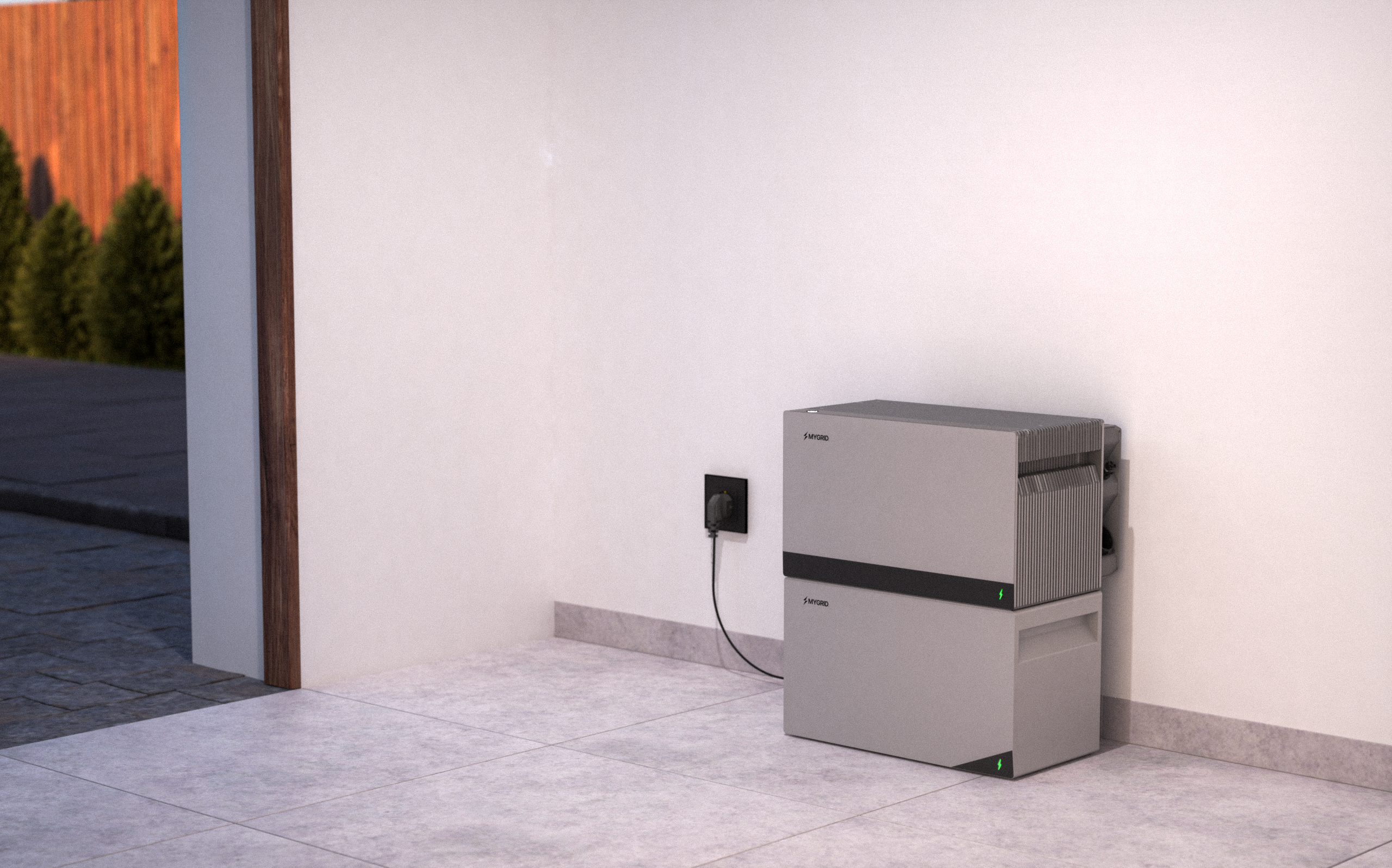
MyGrid ModuleTwo home battery installed beside a home

Store energy at home

Your battery sits at your house and stores electricity for your own household. You stay the owner and the user.

Help lower peaks together

By coordinating when batteries charge and discharge, homes can help flatten the sharpest moments together.

Tuned to your neighbourhood

What is possible depends on the local grid and the project on site. Every area therefore starts with its own exploration.

How a virtual neighbourhood battery works

  1. 01

    Measure what happens

    First it becomes clear how and when the neighbourhood uses electricity. In projects, that insight usually comes from participants' meter data.

  2. 02

    Coordinate for the area

    Next, the useful moments to store or release energy are identified, given local usage and the local grid.

  3. 03

    Lower the peak together

    When several homes shift their moment, less demand lands at once. That is what a virtual neighbourhood battery aims for.

Coordination and agreements differ per neighbourhood project. Together we look at what fits your area.

TIMING

Storing at the right moment

The cheapest electricity price does not always coincide with the most room on the local grid.

When many cars charge at once

With a dynamic tariff, many charging points can start at the same cheap moment. That can create a new peak. By spreading charging out and letting home batteries step in during that peak, the neighbourhood can draw less power from the grid at the same time.

The batteries recharge at moments when there is room locally.

Illustrativewithout coordinationwith coordination

local grid load

quiet momentcheap tariff momentlater in the evening

course of the day

The demand does not disappear: part of it shifts to quieter moments in the neighbourhood.

Keeping room for the solar peak

A battery that is already full early in the morning can no longer absorb the largest solar peak later in the day. By keeping charging room free for the moment when the neighbourhood feeds a lot of power back, more solar electricity can be stored locally.

The right moment to charge depends on the expected generation and the local grid load.

Illustrativereserved charging roomstored energy

stored energy

early morningsolar peakevening

reserved charging room

Reserved charging room can absorb solar electricity from the neighbourhood later in the day.

What is possible depends on the local grid situation and on the available battery power and storage capacity.

Read more about grid congestion

TAKING PART

What does taking part mean for you?

Your battery remains part of your own home. Working together starts with clear agreements about what is possible in your neighbourhood.

The battery remains yours

Your home battery stays with your own household. A neighbourhood project does not change who owns it.

You keep the insight

You continue to follow your own storage and use. Any project data used is explained beforehand for each area.

Agreements are project-specific

How joining and leaving works differs per neighbourhood project. You receive the conditions before making a choice.

Interest is not registration

The form only tells us where there is interest. It is not an order, contract or confirmed project enrolment.

It starts in the neighbourhood.

See how residents in Hilversum and Amsterdam-Sporenburg are working towards smarter use of the local electricity grid.

Hilversum, Raadhuiskwartier

Flex met de wijk

Energy cooperative HilverZon, the municipality of Hilversum and Alliander are exploring how resident insight and participation can lower peaks in the Raadhuiskwartier.

View the project

Amsterdam-Sporenburg

Flexibility in the Eastern Docklands

Sporenburg lies in the Eastern Docklands, where the City of Amsterdam and Liander work with Resourcefully and OpenRemote to ease pressure on the local grid.

View the project

GRID OPERATORS

Local cooperation differs by region.

A neighbourhood project is coordinated with the parties involved locally. Alliander is involved in the Hilversum project. Stedin operates the grid in other Dutch regions; involvement is explored for each area.

AllianderStedin

MyGrid DataLock™

Your energy. Your data. Your control.

A virtual neighbourhood battery enables hundreds of home batteries to charge and discharge together. Together, they shift the load on the local grid, making their control part of critical energy infrastructure. Security is therefore crucial.

This is how thousands of small batteries can contribute to a resilient and secure electricity grid, rather than weaken it.

Co-funded by the European Union

Secured from the chip

ModuleTwo only starts with software approved by MyGrid.

Secure connection

Secure communication between your battery and the MyGrid platform.

Your data stays in the EU

Your MyGrid energy data stays in a European cloud environment that we manage ourselves.

LEARN

Understand neighbourhood energy

Learn how physical and virtual neighbourhood batteries differ, and how smart storage can help with grid congestion.

REGISTER YOUR INTEREST

A neighbourhood battery in your area?

Tell us where you live and who wants to take part locally. Together we explore whether a neighbourhood project is technically and practically feasible. This is not yet a guarantee that a project will start.

An expression of interest is not a final registration yet.

Neighbours talking on a Dutch street with rooftop solar panels
Where do you live?
I am getting in touch as:

0/1000 characters

We use your name, email address and neighbourhood details only to contact you about this enquiry.

Your request is sent only when you press “Send request” yourself.

Frequently asked questions

That the batteries physically stay at the homes and only their behaviour is coordinated. Together they act a little like one larger buffer, without anything shared being built. This set-up is also called a VPP: a virtual power plant, a network of devices that are steered together.

A home battery as part of the whole.

Want to know how a MyGrid home battery works on its own first? Read about it on the ModuleTwo page.

Read about ModuleTwo